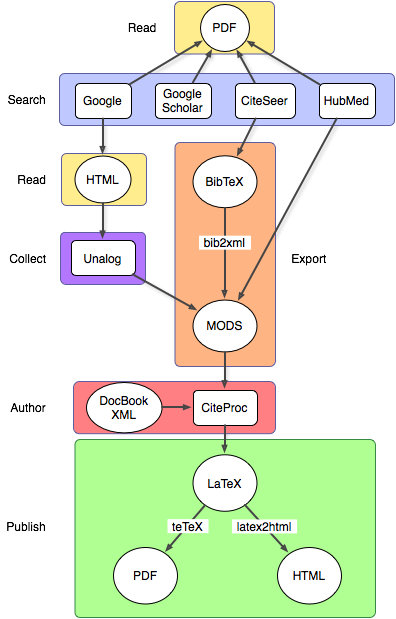
Bruce D'Arcus has been talking about the flow of scholarly data and its metadata, so I thought I'd have a go at modelling the workflow I used most recently. Notice how the PDF sits up there in a dead end, bereft of any useful metadata.
Comments
All fields are optional, email address will not be shown; no HTML, URLs are automatically hyperlinked.


Nice Alf.
One of the reasons I got tripped up diagramming this is that I wanted to include two additional complications. One is that I often want to take notes on references in one place, and then later integrate it into authoring. That's a not-well-integrated aspects of the workflow chain currently.
The other is collaboration. You're using DocBook here (as do I these days), but what if you had to use a standard office product like MS Word or OpenOffice Writer? And what if you had to collaborate with someone who used a different reference manager and/or -- god forbid -- different word processor?
The answer is: stuff breaks. There is effectively zero interoperability.
So I wanted to find a way to show all diagrammatically, and then to show how I'm planing to fix this via some strategic improvements to OpenDocument.
BTW, I mentioned this to Alf off-list: citeproc (I am its author) can output directly to clean XHTML. I think Alf used the latex2html step because he ran into a bug or two in citeproc, and os manually corrected a few things in the LaTeX output. Am hoping we can fix those to make his life easier.
Hi Alf, interesting work as usual. Have you found connotea to be not a worthwhile part of your workflow? I think it exists somewhere between search and collect, for me, with a feedback loop going back to search.
Unalog is taking the place of Connotea here, as it provides MODS output.
Connotea's data model is way too limited to work in this context anyway (at least for me), being designed pretty much exclusively to store journal articles.