TGN1412

There's been a big story in the UK this week about the clinical trial of a drug called TGN1412, produced by TeGenero, which provoked a response in the test subjects that caused intense pain and multiple organ failure. TGN1412 is described as a "humanised agonistic anti-CD28 monoclonal antibody", meaning that it's an antibody that appears human—so as not to be immediately cleared from the body by the immune system—and which stimulates the cell surface receptor CD28. The strange thing is that, in these trials, the antibody seems to have done exactly what you'd expect it to do.

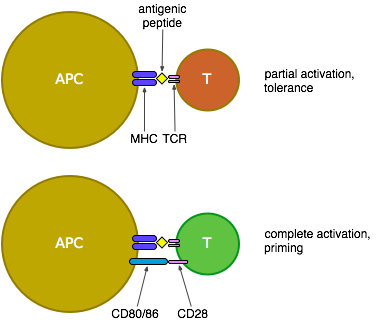
Some background: Antigen-presenting cells (APCs) pick up antigens (generally proteins), break them into small pieces and present them on their surface attached to MHC molecules (see the figure below). If the APC has encountered signals of pathogenicity such as bacterial surface proteins or responses to viral attack while it was picking up the antigen, it will have costimulatory molecules CD80 and CD86 on its surface. When a T cell binds to those small pieces (peptides) of antigen on the surface of an APC, using its T cell receptors (TCRs), it is activated, but in the absence of costimulatory signals (in other words, when the antigen being presented is most likely a protein from a harmless self cell, or a commensal bacteria, or some food or dust) it is only partially activated and ends up either tolerised or deleted (so it can't respond to that antigen in the future) or possibly becomes a regulatory T cell which can suppress the responses of other T cells to that same antigen. If CD80 or CD86 are present on the APC, however, these bind to CD28 on the surface of the T cell which is then fully activated, proliferates and produces an effective response to attack and eliminate the pathogen from which the antigen was derived.
Cd28

An agonist to CD28 would be expected to stimulate T cells in collaboration with antigen recognition through the TCR. If this isn't targeted to T cells of any particular specificity, it could well activate immune responses against both self- and tumour-derived antigens.

In contrast, superagonists of CD28, which are stronger and activate the T cells even without any TCR signal, have also been shown to cause T cell proliferation but are said to result in a larger pool of anti-inflammatory IL-10-producing regulatory T cells (which could suppress future immune responses) than activated T cells (depending on the dose of antibody used). This is the kind of effect that could be useful against inflammatory conditions like rheumatoid arthritis.

TeGenero had suggested that TGN1412, a CD28 superagonist, would be useful for treating both a) inflammatory conditions like rheumatoid arthritis, in which the immune system is overactive and needs to be suppressed and b) B-cell chronic lymphocytic leukemia, in which the immune system needs to be activated in order to attack and eliminate the malignant B cells.

On the TeGenero website, TGN1412 is known as CD28-SuperMAB. As mentioned in a story in The Times, TGN1412/CD28-SuperMAB is similar to the superagonistic antibody JJ316 used in many of the papers listed above (most of which were co-authored by Thomas Hanke and Thomas Hünig who created/discovered TGN1412, both of whom have a a financial interest in TeGenero), but with specificity for human CD28 (probably either monoclonal antibodies 9D7 or 5.11A1). "Although mouse and rat CD28 share 93% sequence identity in the extracellular part of the molecule, human CD28 is only 65% identical to the mouse sequence.". TGN1412 is said to enhance "both cell-mediated anti-tumor immunity and induction of tumor-cell apoptosis". Apparently the massive T cell activation caused by CD28 overstimulation results in the expansion of T cells which a) produce the anti-inflammatory cytokine IL-10 and b) increase the antigen-presenting ability of malignant B cells, bringing them out of stealth mode and making them susceptible to attack.

I can only speculate, as I don't know the details of the experiments and it could have been a problem with the manufacture or administration of the antibody that caused the large adverse reaction in the test subjects, but it does seem like TeGenero are making paradoxical immune-stimulating and anti-inflammatory claims for their drug that haven't been well demonstrated so far. There must be some convincing evidence of the drug's effectiveness though, as otherwise it wouldn't have passed the regulatory process that allows clinical trials to take place.

If it does turn out that the earlier animal trials showed the drug to be effective and safe, then there's a much stronger case against the relevance of research on animals for the development of human treatments. The earlier experiments that TeGenero carried out in animals included rats, rabbits and monkeys, though the details of the later experiments aren't publically available. It seems that the primate experiment may have been simply an ex vivo treatment of cells with TGN1412, which were then injected into 1 rhesus monkey - no side effects were observed. In one paper describing administration of JJ316 to rats, "therapeutic regimens over a broad dose range were never accompanied by detectable side effects. Thus, both the pharmacodynamics and the toxicological profile of CD28 superagonists support broad applicability of this class of antibody in humans."

Comments

I wonder if this Ab cross-reacts with any of the animal CD28s? If it doesn't cross-react, that may be the reason the side effects weren't seen in animals.

Posted by: Tony on March 26, 2006 4:17 PM

The antibody--presumably the same clone--was apparently effective in the 20 Macaca fascicularis (cynomolgous) monkeys [1] in which it was tested, so yes, it seems to cross-react. However, to quote from Wikipedia's discussion page for TGN1412:

"On the question of possible species differences in the reactivity of the superagonist anti-CD28 mAb, TGN1412, the following data should be taken into consideration:

The amino acid (aa) sequence differences between Macaca mulatta monkeys and man is only about 4 % (i.e. 9 of 220 aa) [2,3]. However one of these substitutions (a glutamic acid for a glycine at the 83rd position in the protein sequence) occurs in what has been crystallographically determined to be a point of contact between CD28 and the active site of the antibody in question [4].The exchange of uncharged glycine with the larger negatively-charged glutamic acid is likely to have a marked effect on the strength of antibody-antigen interaction. That is to say, TGN1412’s binding affinity for Macaca CD28 (and thereby its potency as an immunoreactive drug) may be several orders of magnitude lower than that for human CD28. Direct measurement of the binding affinities of TGN1412 for both human and Macaca CD28 would appear to be of critical importance in assessing the relative potency of TGN1412 in the two species."

On the other hand, CD28 in other species of macaque has even higher similarity to human CD28. Here's an alignment of Macaca mulatta, Macaca nemestrina (there doesn't seem to be any sequence data for Macaca fascicularis) and Homo sapiens CD28 protein sequences:
http://www.ch.embnet.org/wwwtmp/sq.14715.aln

Note that there are no differences between the human and Macaca nemestrina sequences around the presumed TGN1412 binding site.

1) http://www.sciencemag.org/cgi/content/full/311/5768/1688
2) http://www.ncbi.nlm.nih.gov/entrez/viewer.fcgi?db=protein&val=5453611
3) http://www.ncbi.nlm.nih.gov/entrez/viewer.fcgi?db=protein&val=13650008
4) http://www.hubmed.org/display.cgi?uids=15696168

In the mouse, CD28 is also expressed by mast cells. If this is also true in humans, then binding this "super" antibody to CD28 could inititate an allergic response within minutes of administration, exactly as described in the press accounts. The response of the patients could have nothing to do with this antibody actually binding to T cells.

A small skin blister test with this antibody could demonstrate such a response if it was mast cell/basophil mediated.

Posted by: Anonymous on April 3, 2006 9:58 AM

If CD28 on mast cells was affected by this antibody then you would have expected to have seen this allergic response in mice too, which apparently didn't happen.

Posted by: alf on April 5, 2006 2:46 AM

Thanks for this site which is extremely interesting. I have a question though. If you overstimulate cd28 (without the t-cell receptor encountering its activating antigen) and thus activate the cd8 T-cell, how does it know which antigen to attack? It seems in this experiment, all the T-cells went into overdrive - proliferating and attacking everything in sight - (the patients were presumably treated with huge doses of steroids +/- other immunomodulating drugs). So how does the manufacturer propose the increased number of regulatory T-cells counteract overactive T-cell attack in eg. RA? Thanks again.

Posted by: Dave Jones on April 5, 2006 1:21 PM

Dave, as described in the papers linked above, the researchers had found in animals that although the CD28 superagonist antibodies activated T cells non-specifically, the proportion of regulatory CD4+ T cells was increased, which presumably kept the autoimmune effects under control.

Posted by: alf on April 9, 2006 7:05 PM

Having read the MHRA interim report, it appears possible, with hindsight and given the available evidence (a lot of which has been withheld), that the TGN1412 given to cynomolgous monkeys had no significant effect at all other than inducing an anti-antibody response in a few of the animals.

Given that TeGenero's application states that there is 100% homology between the structure of CD28 in the rhesus (Macaca mulatta) and cynomolgous (Macaca fascicularis) monkeys and humans, which clearly isn't the case according to published sequences for Macaca mulatta and human CD28 (see links below), it seems very possible that the effect of strong CD28 stimulation was only seen once the antibody was injected into the human trial subjects.

Alignment of Macaca mulatta, Macaca nemestrina and Homo sapiens CD28 protein sequences:
http://hublog.hubmed.org/files/sq.23086.aln

Important residues in the protein sequence of CD28 and related molecules in humans and mice:
http://hublog.hubmed.org/files/cd28-alignment.jpg
from http://dx.doi.org/10.1182/blood-2004-04-1596

The report also mentions that TGN1412 bound to cells, possibly astrocytes, in the brain, spinal cord and pituitary gland of humans and monkeys during histological staining. However, this is thought unlikely to have had an effect in vivo as the large size of the administered IgG molecule would prevent it from crossing an intact blood-brain barrier.

True, immunoglobulins aren't expected to cross the BBB. Resting T cells do not cross the BBB; however, activated T cells CAN cross the BBB - one mechanism for mediation of neurological damage in MS, etc. - please see http://www.hubmed.org/display.cgi?uids=3323405
J Exp Biol. 1987 Sep;132:43-57.
Immune reactivity in the nervous system: modulation of T-lymphocyte activation by glial cells.

- and interestingly, astrocytes are mentioned in this context.

Posted by: shannon on April 18, 2006 5:07 PM

All fields are optional, email address will not be shown; no HTML, URLs are automatically hyperlinked.